Internet of Things:
IoT concept
was first said in mid 1990’s by Kevin Ashton, The co-founder and executive director of MIT’s Auto-ID lab. (Rayport, 2013)
“The
predictable pathways of information are changing: the physical world itself is
becoming a type of information system. In what’s called the Internet of Things,
sensors and actuators embedded in physical objects—from roadways to
pacemakers—are linked through wired and wireless networks, often using the same
Internet Protocol (IP) that connects the Internet. These networks churn out
huge volumes of data that flow to computers for analysis. When objects can both
sense the environment and communicate, they become tools for understanding
complexity and responding to it swiftly. What’s revolutionary in all this is
that these physical information systems are now beginning to be deployed, and
some of them even work largely without human intervention.” (Chui, 2010)
Big Data:
When you
consider all these collected data from the existing web sites, huge companies’
databases and “things” connected to Internet, this should make you scare.
Because these data is as complex as you can handle if you don’t use how to
harvest and how to convert them into meaningful information. “Big data” concept
is a fresh topic because in nowadays industries there are many field that can
be analyzed and measured so that you can benefit from the outputs.
I will
analyze telecommunication industry which
I was working for. Mobile operators provide services for the customers to
communicate each other. And all the service providers used to focus on voice
and SMS in last decade. Nowadays they realized that all the “things” need to be
connected to internet. Then “data” concept became a priority. Besides, number
of the things connected to internet is rapidly increasing as it is showed in below
graphic:
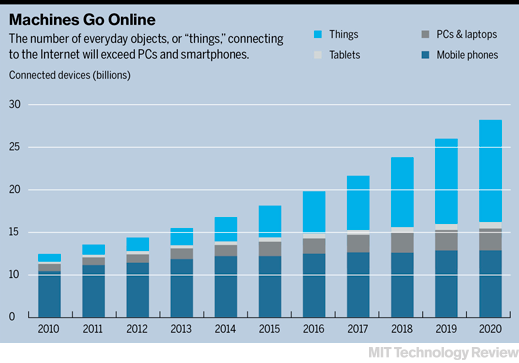
As it is
increasingly huge, the service providers needed to focus more on “data”. Hence
their way of doing business had to change completely. Their way of marketing
services had to change as well. Beyond all, the main target group is shifted
accordingly. With the IoT, many new markets occurred. Some of them are vehicle
tracking systems, remote meter reading systems and home automation systems.
This means that most of the cars are connected to internet. Most of the houses
can report its electricity consumption automatically and so on. When you sum
all the numbers of cars, houses and industrial devices that can be connected
internet wirelessly or wired, it will give you the size of the market. This
shows us the size of the market is as huge as we cannot measure precisely. To
understand the size of it one step more, we can see the microprocessors
produced every year. “There are about 25 billion microprocessors made every
year, compared to about one billion mobile phones. So we’re talking about a
potential constituency that is 25 times larger than the current cellular
market.” (James Collier)
The service
providers will move their marketing target group from individuals to
enterprises. The business model harmony will be shuffled again between B2C and
B2B. So, the companies should create new departments to understand needs of B2B
market and create marketing strategies and technologies accordingly.
This growth
in industry and retail market will require big data storages and wide wireless coverage
and reliability. Hence, for the service providers the data infrastructure and
network architecture will need to be extended, upgraded and renewed.
When it
comes to financial perspective, the situation is not very different. You might
remember that Google acquired Nest which is mainly focused on smart thermostats
connected to internet for $3,2 billion. Google took a step. The biggest
companies somehow have to convert their technology with the data coming from
IoT similarly. The situation is the same for the mobile operators. They need to
have know-how of harvesting the “bit data” they have. This means that they have
to separate really big amounts of budgets to make meaningful information that
they can leverage their business against their competitors.
As data
conveyors, telecom operators can provide the data that they collected for the
specific industries to have advantage in marketing investments. Thus, telecom
operators should know how to mine and create meaningful data for each
industries that they want to sell data. As an example to this, Google is a
company which provides search engine service to the web users. But when you
look in business model point of view, Google is a “Big Data” company. Google is
making money from its advertisement services. And what makes Google good
advertisement platform is its technical ability to provide the “big data” as
useful information for the advertisers to find their particular segmented
target group.
In management perspective, action plans could
be as follows:
Technology:
When the data getting bigger, managing that is being more difficult. The only
thing to achieve this chaos is creating new tools and software. When you have
right tools and technology growing amount of data will be opportunity for you
instead of chaos. The telecom operators should have the technology
infrastructure that they can build new business connections with new and
emerging industries.
People: If
you are in emerging market, you will have to fight against smart competitors.
It means even if you have enough technology, you will have to increase and
innovate your technology in handy as well. You will need to leverage data to
meaningful information and so on. In this point, you will need to business
analysts and human resources to automate these converting processes. The
telecom operators should discover new fields where their potential customers
needs meaningful data or connectivity options for their devices.
Bibliography
Chui, M. (2010). The Internet of Things. McKinsey .
Davenport, T.. What Makes Big Data Projects
Succeed. http://blogs.hbr.org/:
http://blogs.hbr.org/2014/03/what-makes-big-data-projects-succeed/ adresinden
alınmıştır
James Collier, F. a. . MNOs will not make the IoT
connection. http://www.telecoms.com/:
http://www.telecoms.com/163802/mnos-will-not-make-the-iot-connection/
Rayport, J. F. (2013). Advertising and the Internet of
Things. Harward Business Review.

